My friends at RabCup here in Los Angeles recently made this cool video that features a number of my designs, seen at high-profile venues from Washington DC to Las Vegas and beyond.
/blog
-
VSx Visuals in Barcelona

Finishing off 2019 with a live audiovisual set in Barcelona: this was an opportunity to give the latest version of the live performance video tool a test run in front of a festival audience. With only minor UI issues that were easily worked around, the touchscreen-driven visual instrument performed admirably on stage. On return, I used VSx (after “VS3,” “VS4” and “VS5” I’ve given up on numbers as a naming convention) as a presentation tool (imagine a realtime motion graphics version of a PowerPoint deck) at a local Los Angeles forum to tell the story of the event and describe some key features of the application. With the full feature set now tested in front of live, discerning audiences, I’m looking forward to further visual adventures in 2020.
-
A VS4 Discussion in DTLA
In July 2018 at a venue in downtown LA I gave a talk that described some of the background, historical references and motivation behind the development of the VS4 project. This discussion touched upon a range of topics — from Wagner and early 20th-century avant-garde art, to UX and design of the current revision of the software visual instrument.
The venue was spec.la, a monthly salon-sort-of-event for inventors, artists and various types of mad scientists. While the sessions are invite-only, videos of many of the varied presentations are freely available on YouTube.
-
VS4 Visual Synthesizer Beta
 The VS4 (“Visual Synthesizer, iteration 4”) project is finally at a point where it can be called a Beta version. While I’ve just been running simple test patterns through it so far, the basic architecture and feature set of this tool for audiovisual performance and real-time motion graphics are pretty much complete and functional (though there are still a number of secondary features and options that need to be implemented before it’s really usable; “Bare Bones Beta” might be a more accurate title).
This is the first in a suite of three tools (and associated processes) currently under development for furthering realtime audiovisual experiences and interactive storytelling across multiple media. While each component has a distinct purpose and audience (ranging from practical to experimental, commercial to fine art, tactical to theoretical), they all share a common architecture built around symbolic structures and patterns. (more…)
-
Art and Technics
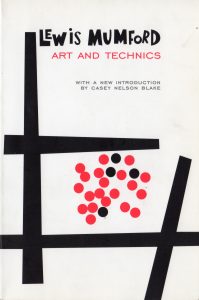
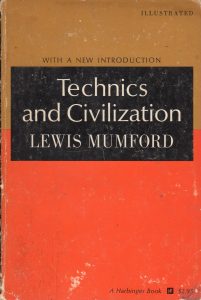 It’s no secret to my friends that I love bookstores (especially used bookstores, and the less organized, the more chaotic, the better). I think of a proper bookstore as a sort of “synchronicity engine”: an environment where things seem to find me, rather than the other way around; a place where I discover that which I didn’t know I was looking for. Here’s an example: A while back I ran across a battered old copy of Lewis Mumford’s Technics and Civilization (1934). While full of thought-provoking concepts (for instance, the idea that the “key-machine” of the Industrial Revolution was not the steam-engine but the clock – information technology!), what I found even more valuable were references to his later (1952) work, Art and Technics (with which, I must confess, I was not familiar). Then, on my next trip to The Last Bookstore, downtown – well, what do you know? – there happened to be a (much-less-battered) copy of Art and Technics waiting for me.
Lewis Mumford was a philosopher of technology (among other things). Interestingly, particularly so for anyone involved with information technology, he was also a friend of Vannevar Bush (not to mention Frank Lloyd Wright).
I find it remarkable how his ideas still resonate, over a half-century later. He was very much concerned with how (or whether) modern humans might achieve a balance between what he described – in mythological terms – as the influence of Prometheus (aspects of human existence driven by technology) as well as Orpheus (aspects of human existence driven by what could be labeled as “art”). Control of the external world, and expression of the internal world: both are necessary for a healthy existence – but in modern times, Mumford asserts, we have fallen out of balance:
“… unable to bring the various parts of … life into harmony, … [we have] traded wholeness … for order, order of a limited, mechanical kind.”
One result of this negotiation is the proliferation, the repetition of symbols and images – and with it a corresponding “terrible … burden: the duty to constantly consume.” And consuming is easy, of course, but the meaning of that which is consumed with such convenience begins to fade. Once symbols become endlessly reproduced they lose their potency. Once a work of art “has reached a certain point of super-saturation … it sinks into the background; indeed, it disappears”
Eventually we reach a place, described by Mumford decades ago in terms that sound very much like our present social media-driven environment:
 “… we cease to live in the multidimensional world of reality … we have substituted for this … a secondhand world, a ghost-world, in which everyone lives a secondhand and derivative life. The Greeks had a name for this pallid simulacrum of real existence: the called it Hades, and this kingdom of shadows seems to be the ultimate destination of our mechanistic and mammonistic culture.”
Once, humans experienced the world, and each other, directly – but “now it is actual experience that is rare.”
Mumford’s theories of course referenced the technology of the day: physical machines and mechanical reproduction. What, do you suppose, he would say about the present proliferation of images and media through digital reproduction: incessant reposting, retweeting, reproduction of everything from the sublime to the banal, exponentially, ad infinitum … ?
In 1952 he wrote, “We are rapidly dividing the world into two classes: a minority who act, increasingly, for the benefit of the reproductive process, and a majority whose entire life is spent serving as the passive appreciators or willing victims of this reproductive process.”
Since the 1950s some things have changed. One is that in the present era (i.e., of social media), democratization is found not just in the experience of art and media, but also in the production of the media we consume: now people spend their lives as passive appreciators not only of the actions of a minority (presumably at least somewhat qualified, in Mumford’s day), but as passive appreciators of the contributions of anyone and everyone. It’s doubtful that Mumford would consider this a positive development; rather, I imagine he would see the ubiquitous mobile devices and social media apps as taking the “secondhand world” and the “pallid simulacrum of real existence” to a new level (or, rather, depth).
In the final chapter of Art and Technics, Mumford summarizes the state of the balance (over a half-century ago, but, again, his statements still seem quite valid today): tools and technology, “once so responsive to man’s will … threatens to turn man himself into a mere passive tool.”
In the era of Facebook, one could say we’ve become “tools for consuming,” driven by algorithms based on psychometric calculation.
But then Mumford offers some hope for the future, which may also still be valid:
“…the creative impulses that stirred in the human soul hundreds of thousands of years ago, when man’s inquisitiveness and manipulativeness and growing intelligence and sensitivity caused him to throw off his animal lethargy – these deep impulses will not vanish …”
“… it is in the nature of life itself to seek to resume equilibrium … While life persists, it holds the possibility of circumventing its errors, or surmounting its misfortunes, of renewing its creativity.”
-
RPG Musings
 “As I learned more about how these early role-playing games [RPGs] worked, I realized that a D&D module was the primitive equivalent of a quest in the OASIS [a multi-user VR environment of the near future]. And D&D characters were just like avatars. In a way, these old role-playing games had been the first virtual-reality simulations, created long before computers were powerful enough to do the job. In those days, if you wanted to escape to another world, you had to create it yourself, using your brain, some paper, pencils, dice, and a few rule books. This realization blew my mind.”
(more…) -
The Continuing Studio Project
 Over the last few months we’ve been working on building out our new studio: a hybrid playground where we can work with old-school synthesizers, effects, and mixers as well as all the latest digital tools. It’s been a pretty epic project, so far, as we not only had to rebuild a bunch of equipment, but we also had to get a number of the essential (and large) items from the east coast to Los Angeles.
From the pubs of Boston, through Nashville and Marfa, Texas, to long late-night hours with test equipment and soldering irons in our shop in downtown LA, it’s been a lot of work but also a lot of fun … and we’ve been documenting the process in the Coredark blog:
(more…) -
Virtual Reality in Context
This post was originally composed earlier this year as a white paper for Inhance Digital following the production of the agency’s first two Oculus-driven virtual reality experiences.
Every medium is a context for a message, with characteristics that shape any narrative it conveys. At the same time, every medium has its own contexts: historical, cultural, and technological. These two assertions could not be more relevant in the case of what we call virtual reality (VR) — and an understanding of the various aspects of these contexts is valuable when imagining and designing VR experiences.
VR in the history of technology and popular culture
Alternate realities have been a part of human culture for as long as there has been human culture, manifested as religious experience, dreams, meditative states and other altered states of consciousness. The idea is nothing new, to be sure, but in these historical examples the nature of the experience — the “content,” as reported by the conscious mind — comes from elsewhere: it’s attributed perhaps to divine intervention, or, later, as analytical psychology developed, the depths of the unconscious. Many possible sources are posited, but none would be considered intentional, rational products of the human mind.
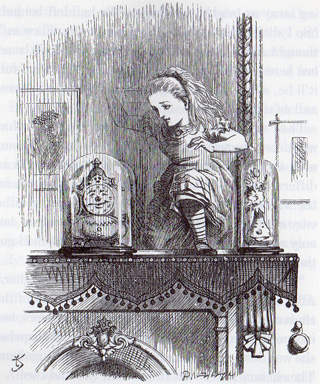
John Tenniel’s illustration from
Through The Looking-Glass by Lewis CarrollAlice might pass through the looking glass, but few considered the idea that she might create a new looking-glass world of her own, where others could explore and learn.
It was in the 20th century that a new concept began to take hold in popular culture: the possibility that humans themselves could consciously and deliberately create and control immersive and complete alternate realities 1.
The seed for the concept of these sorts of artificial realities may have been planted around the end of the 19th century, with the advent of photography and cinema: devices which allowed one to create a startlingly (at the time) realistic representation of the real world. While these examples existed only within a frame or proscenium, the futurists of the era soon began to extrapolate and imagine where new technology could take us.
From the state of “half-life,” a form of cryonic suspension that maintains consciousness and the ability to communicate described by author Philip K. Dick in his novel Ubik (1969), to the idea of “the Matrix” — a “cyberspace” where people are “jacked in” their entire lives in the film of the same name (1999) – artificial realities have been an increasingly significant part of popular culture and contemporary mythology.
The term “cyberspace” was introduced in the 1980s by author William Gibson, first in his short story Burning Chrome (1982) and later in Neuromancer (1984): “Cyberspace. A consensual hallucination experienced daily … A graphic representation of data abstracted from the banks of every computer in the human system … Lines of light ranged in the nonspace of the mind, clusters and constellations of data. Like city lights, receding.” In Gibson’s world, “jacking in” involved complete immersion in the artificial environment.
In cinema, these concepts were popularized by movies such as TRON (1982), Brainstorm (1983), The Lawnmower Man (1992), and Virtuosity (1995).
About the same time, actual VR technology — previously found primarily in esoteric military, academic and industrial applications 2 — began to become accessible to the general public. Jaron Lanier, one of the modern pioneers of the field (and who popularized the term “virtual reality”) founded the company VPL Research in 1985, releasing consumer-level VR products including a head-mounted display that could track the user’s movements.
In 1991 Sega announced the Sega VR headset with LCD screens in a visor and inertial sensors that allowed the system to track and react to the movements of the user’s head. The Virtual Boy was created by Nintendo and released in 1995.
But the former never reached beyond the prototype stage; the latter was a commercial failure. And by the end of the century popular culture seemed to lose interest in VR offerings as mainstream products. Indeed it became something of a joke: “the ‘death of VR’ had become a standard narrative.”3 Why? One reason might be that the technology just didn’t work very well: the sensors, processors, and display technology simply weren’t up to the task of creating a truly responsive, immersive environment.
But now all this is changing.
Today, advanced sensor technology, powerful CPUs and graphics processors combined with high resolution displays are catching up with the intentions of artists and experience designers, and are available at low cost on consumer-level equipment.
It’s worth pointing out that as of this writing, the technology still hasn’t quite fully arrived: the Oculus Rift DK2 is not yet a real, shipping product, and the Samsung Gear VR is still labeled an “Innovator Edition,” meaning that it is “intended specifically for developers and early adopters of technology” — but nonetheless the platforms are functional and ready to be exploited.
VR technology now joins photography, cinema, and interactive media as not just a way to create immersive environments and experiences, but an increasingly viable way to convey messages and tell stories.
What differentiates a “virtual reality” experience from one that is simply “immersive?”
The term “immersive” is defined as “pertaining to digital technology or images that deeply involve one’s senses and may create an altered mental state” — and there are many ways to create an experience that fits this description.
One method that has been used for years involves the use of multiple video projectors to fill a room with video, surrounding the audience, coupled with multi-channel audio. Inhance has created numerous “surround theaters” of this sort, including an installation for NASA that allowed a group of people to experience the illusion of standing on the surface of the moon.
All virtual reality (VR) platforms meet the basic criteria of being “immersive.” But a modern VR platform creates an individualized experience, using dedicated hardware that typically involves, at a minimum, the use of two specialized technologies:
- Stereoscopic displays
- Head-mounted movement tracking
Stereoscopic displays present independent video images to each eye of the viewer, generating the illusion of a three-dimensional world with depth.
A head-mounted display (HMD) with sensors such as accelerometer, gyrometer and magnetometer allow the software driving the system to track the position of the viewer’s head, and generate in real time an image of the virtual world that is consistent with the direction in which the viewer is looking. This must be accomplished at a very rapid rate in order to create a “believable” experience (and avoid discomfort).
Headphones for stereo music and sound effects are also a typical component of the system. Additional components that can increase the sense of full immersion may include proximity sensors, 3D audio, force feedback, and controllers such as sensor-equipped gloves and omnidirectional treadmills.
The result is an unprecedented level of realism and a range of new possibilities for interaction within a virtual world.
How does this change the way we tell stories?
The range of potential applications for fully immersive worlds — including environments that could never exist in reality — is vast. The technology opens myriad possibilities for communication that we are only beginning to exploit.
But it also subverts some long-standing assumptions and methodologies, and new paradigms for the medium have not yet been fully developed.
Traditional storytelling techniques have historically involved the assumption that the attention of the audience will be directed at a particular point, and there are many well-understood ways to manipulate or guide a subject’s attention. But in a VR world we’ve essentially handed over control to the viewer.
This means that many essential filmmaking techniques — approaches we use every day to create “traditional” visual narratives — won’t work in the VR world. Cinematic storytelling has long relied on precise control of the camera (e.g., manipulating depth of field, racking focus) and the art of continuity editing. Lighting for film usually depends on a given camera position and angle, among other parameters. We must now find ways to communicate the desired message while recognizing that many of these elements have become unpredictable.
As visual artists we also rely on design techniques that have been in use for hundreds if not thousands of years. Among these among these are the rules of composition that we learned our first year in art school: the rule of thirds, the golden mean, and so on. But in a 360-degree VR environment, it’s not possible to apply traditional rules of composition in the same way: without a “frame” around our experience, many of these old approaches no longer apply.
These are issues in any interactive environment, it could be argued, particularly in games driven by real time 3D engines, but usually in such cases there’s at least a frame, edges where the experience starts and ends — these are reference points that a VR platform is designed to eliminate.
Clearly, as the level of interactivity and immersion increases, so do the possibilities — but also the design challenges.
On a practical level, we must also consider the fact that while in a VR environment there are 360 degrees of visual information around the viewer, typically only 90-100 degrees of this is visible at one time, and the viewing angle cannot be predicted. This means the viewer will never see everything: the larger part of one’s hard work (and potentially one’s message) will simply be ignored (nonetheless, the full 360-degree environment must be modeled and rendered — a significantly greater amount of work and render cycles than in the case of a traditional 16×9 piece). Of course, allowing the audience to make multiple passes through the experience is often an option, and in some contexts this may also be desirable — but not always.
Finally, like any powerful technology, VR is not without the potential for potentially harmful misuse.
While not typically known for putting audiences in physical peril 4, interactive multimedia can involve various sorts of potentially harmful circumstances. In the case of a VR experience, the experience may indeed be “all in your head” — but as a fellow named Morpheus famously remarked, “the body cannot live without the mind” and, similarly, real physical discomfort (or worse) can result if we are not careful in what we are presenting.
The experiential “uncanny valley”
The term “uncanny valley” refers to a hypothesis in the field of aesthetics which holds that when anthropomorphic entities look and move almost — but not exactly — like natural beings, it causes a response of revulsion among some observers. For example, if a person sees an image of another (healthy) person, likewise an image of a simple doll, this is not likely to cause a negative response under normal circumstances. However the image of a realistic human likeness, say, an automaton — that is almost real but not quite natural — can be very disturbing.
While for different reasons, we noticed an analogous response to stimuli in a VR environment.
The response time and level of immersion is such that the mind “wants” to believe the experience is real. We noticed that dramatic violations of real world paradigms (e.g., laws of physics) that immediately dispel suspension of disbelief tend to generate less discomfort than subtle aspects of a virtual experience that the cognitive apparatus is trying to process but where something just isn’t quite right. For instance, in our testing we’ve found that when taking the viewer on a virtual “roller coaster ride” or fly-through, slow sweeping banked turns can actually be more disconcerting than dramatic swoops and dives.
“Simulator sickness” is a form of visually induced motion sickness, characterized by symptoms including disorientation (disrupted balance), oculomotor discomfort (e.g., eyestrain), and nausea. Sources of discomfort include the following: 5
- The sensory conflict that occurs when motion (acceleration) is conveyed visually but not to the vestibular organs
- Movement in the virtual world in ways that are not natural or predictable
- A limited or dynamic degree of control allowed to the viewer
- Extended intervals of time spent within the experience
And we must be aware (and make our audiences aware) of the lengthy list of health and safety guidelines associated with a VR experience, including the need to remain seated during the experience (as one may become disoriented or lose balance), the warning against use of the equipment by children under 13 (due to the potential adverse effects on visual and cognitive development) or people with a variety of medical conditions. And even for healthy users, a slight disorientation (like “sea legs”) can persist even after the experience is over, and audience members must be reminded that driving or use of heavy machinery should be avoided until all such symptoms disappear.
The application of VR experiences
Challenges notwithstanding, VR clearly offers immense opportunity to create experiences and tell stories in new and compelling ways. But is this really “the future?” Should every marketer — everyone with a story to tell — be running out and deploying VR systems in their exhibits, trade show booths, theaters and presentation centers?
As when one is considering any new medium or technology, the first step is to ask, “what is the story we’re trying to tell?” or “what is the transformation on the part of the audience we are trying to create?” — and then examine the opportunities provided by the technology in question and assess how they align with the goals. In the case of a VR platform, there are a number of obvious ways to further a range of narratives, including:
- The novelty and intensity factor: for the large number of people who have not used modern VR hardware, the depth of the experience is truly amazing, and the system is an example of new, cool tech.
- Making inaccessible environments accessible: real-world locations that are dangerous or otherwise restricted become available to general audiences of non-specialists.
- Creating environments that don’t (or can’t) exist in the real world: conceptual, dynamic and interactive environments can only explored in an artificial reality.
If the story to be told involves a theme of innovation, the VR medium can be the message, as in the Raytheon Oculus 360 Cyber Experience at the RSA trade show in San Francisco. This opportunity is likely, however, to be of limited duration, as the technology becomes increasingly mainstream.
Deepwater VR The virtual world is well suited to stories involving places or environments where the audience could not otherwise go. This was the theme of the Shell Deepwater VR experience at the New Orleans Jazz and Heritage Festival (“go where no one else can go”) where the audience traveled to an offshore oil production platform, the sea floor, and all the way to outer space.
Similarly, futuristic or abstract environments can be visualized and explored, as in the Raytheon experience, where the “world of invisible data” was made visible in three dimensions. The nature of the 360-degree environment itself can also speak to narrative themes like ubiquity, unlimited possibility, and the idea of being surrounded by events or activity on all sides and is an excellent medium for any idea related to information overload or sensory overstimulation.
There are also some potential disadvantages of a VR experience to consider. The experience is usually available only to a limited audience: every member of the audience must have a dedicated set of hardware, and use of the hardware is not recommended for everyone (e.g., children under 13, those with certain medical conditions, etc.). And VR experiences are highly individual; audience members are literally cut off from the real world and each other. They may have robust interactions with the virtual environment, but no interactions with each other — so we don’t get the benefits of a shared experience, unless it is in the form of avatars in the virtual environment.
We’re still “physical.”

“We’re not computers, Sebastian. We’re physical.”
Rutger Hauer as Roy Batty
in Blade RunnerWhile one of the primary perceived advantages of a VR experience is the ability to place the audience in an immersive environment with the characteristics of three-dimensional space, research has brought into question the extent to which learning (involving spatial references, at least) is possible in a simulated environment that doesn’t involve actual, physical movement. From a famous experiment 6 involving cats “that were restricted such that they could not explore space through their own body movements … it was deduced that an ‘intelligent’ orientation in space, or any generally ‘intelligent’ behavior, develops from an active senso-motor exploration of the environment.” 7
Another consideration is whether the narrative in question is better served by a linear or an interactive experience.
The VR environment is, of course, inherently interactive, at the very least in that the viewer has control at all times of the angle of view: the system is constantly tracking the motion of the viewer’s head and generating an appropriate stereoscopic image consistent with the direction the viewer is looking. It’s worth noting, however, that this interaction is so subtle in modern VR systems that the viewer won’t even realize it’s happening — it just feels “real” (this is analogous to the example of continuity film editing, where you only notice it when it’s not working, otherwise the art and science is completely invisible).
A VR experience may be a sort of “roller coaster ride,” where the viewer is transported through a virtual environment as if on rails. In such a scenario, the viewer has limited control over motion, but still has complete freedom to look around in any direction. Even this limited level of interaction allows for myriad possibilities and many alternate narratives, as at any given moment the viewer will only be experiencing a fraction of the available visual information.
This type of scenario is suited to more traditional, linear stories, driven by a “cinematic” narrative with a beginning, development, and conclusion, predetermined timing and transitions, and a specific intended path through the virtual world.
The Raytheon and Shell experiences were of this type, where once the viewer had advanced past the initial “lobby” experience, they were essentially viewing playback of a 360-degree stereoscopic movie. This approach served these stories well, as in each there was a specific sequence of events and information we wanted the viewer to experience.
But it’s not the only possible approach. Alternatively, through the use of a real time engine the experience of the virtual world can be completely non-linear and interactive. Movement, direction, and manipulation of objects are under the control of the viewer. There is no predetermined timing or path. This approach is well suited to themes of freedom and exploration, or scenarios where the environment needs to be dynamic, responding to (or challenging) the viewer.
At Inhance we’re exploring all these options and more as part of our continuing process of exploiting the latest technological innovations to create new kinds of experiences – while maintaining a balanced perspective and considering all our options within the appropriate contextual frameworks. To think, for instance, in terms of “virtual” versus ”actual” is to subscribe to a false dialectic 8 since we all – as humans in the present era – live in a continuously dynamic, shifting space between and combining the two. And ultimately what we are developing are new tools for expression, that while extraordinarily powerful are only one more step in the long and multidimensional history of storytelling.
Endnotes
[1] The word “virtual” has an interesting (and somewhat sexist) history. The origin is the Latin virtus, meaning “potency” or “efficacy” – literally “manliness” – and is related to the root of “virile,” meaning, among other things, “capable of [pro]creation.” From this perspective, the salient aspect of “virtual reality” is not the fact that it is somehow artificial as opposed to actual – but rather that it is actively generated by man, creator of narratives, the storytelling animal.
[2] Personal simulation and telepresence environments have been around for a while. Immersive images have been used in the field of aerospace simulation for decades. In 1958, the Philco Corporation created one of the first telepresence visual systems using a CRT mounted on the operator’s head driven by a remote camera. “Sensorama,” an arcade game prototype developed by Morton Heilig in the mid-1960s provided a multisensory environment that included vibration and a chemical smell bank. In the late 1960s, a head-mounted display concept by Ivan Sutherland at MIT’s Draper Lab allowed computer-generated objects to be superimposed onto the real environment. An early example of an environment where viewers were able to control their own viewpoints or motion is the Aspen Movie Map, created by the MIT Architecture Machine Group in the late 1970s: using pre-recorded footage, an operator could “drive” through the town of Aspen, taking any route they chose. The Virtual Environment Workstation (VIEW) project developed at NASA Ames Research Center in the mid-1980s is another example of a helmet-mounted display technology with the addition of auditory, speech and gesture interaction within a virtual environment. “Tour of the Universe” (1985) in Toronto and “Star Tours” (1987) at Disneyland were among the first commercial entertainment applications of simulation technology and virtual display environments. The CAVE (CAVE Automatic Virtual Environment), a projection-based immersive visual and audio environment was created at the Electronic Visualization Lab and the University of Illinois in 1992.
It’s worth noting an interesting connection between the genesis of VR and music: As Benjamin Woolley has observed, Sutherland was inspired by the Link Trainer flight simulator. Edwin Link developed the first flight trainer in 1930, based on the pneumatic mechanism of player pianos.
Some sources for further reading:
- Scott Fisher’s article “Virtual Interface Environments”: Packer, Randall and Jordan, Ken, editors, Multimedia – From Wagner to Virtual Reality (W.W. Norton & Company, New York, 1989).
- A Critical History of Computer Graphics and Animation, Section 17: Virtual Reality
- Benjamin Woolley, Virtual Worlds: A Journey in Hype and Hyperreality, (Blackwell, 1992)
[3] The history of VR through the words of important historical figures themselves is found in the highly entertaining article, Voices from a Virtual Past, compiled by Adi Robertson and Michael Zelenko.
[4] The word “typically” was chosen carefully, here. A recent project involving high power lasers mounted on robots dancing within inches of the faces in the audience comes to mind, but that’s another story.
[5] The source of most of this information, and an excellent reference in general, is the Best Practices Guide from the Oculus developer documentation.
[6] R. Held and A. Hein, “Movement-produced stimulation in the development of visually guided behavior,” in Journal of Comparative Physiology and Psychology 56, pp. 872-876.
[7] Rotzer, Florian, “Images Within Images, or, From the Image to the Virtual World” from the collection Iterations: The New Image, edited by Timothy Druckrey (Cambridge, MA: The MIT Press, 1993), 64.
[8] Zellner, Peter, Hybrid Space: New Forms in Digital Architecture (New York, NY: Rizzoli, 1999), 10.
-
Process vs. Product
This is a story from a long time ago. It has come up again and again in various contexts, but the message, the meaning, remains consistent; an essential concept that remains relevant to just about everything I do.
This iteration begins at one of my favorite bookstores, Skylight Books in Los Feliz, where I discovered an intriguing little tome: The Pictorial Webster’s – a collection of engravings from the 19th century Webster’s dictionaries. I love this sort of thing (indeed, there’s an 1892 Webster’s sitting on my shelf right now, that contains a number of the same wonderful images) and I perused the pages for a while; then I flipped to the beginning and noticed the dedication: for Sam Walker (1950-1999).
 Could this be the same Sam Walker I once knew? My teacher and advisor when I was studying art in Boston, back in the ’90s? There were a number of clues suggesting so: the dates were about right (Sam Walker, the professor, I later learned, died shortly after I graduated); also the author of this collection, John M. Carrera, was from the Boston area and is a printmaker (I knew Professor Walker as a drawing instructor, but printmaking was his primary medium).
An interesting bit of synchronicity.
And it prompts me to retell the “process vs. product” story, once again …
Years ago, in art school, one of my studio classes was a drawing workshop led by Professor Walker. Usually a session involved three or four hours of drawing in charcoal or pencil or ink, often with models. From time to time there was a lecture before we started working, and on one occasion we arrived in the studio to find an array of varied images tacked on the wall – ranging from student works to recognizable drawings by well-known masters. The professor announced that we’d be having a discussion before we started drawing that day, and the topic was a simple question:
Look at all these images …
… and I want you to tell me which ones are … art.Now this being a studio class, most of us assumed we’d be having a technical discussion, weighing the effectiveness of one technique or medium over another or judging the relative rendering ability of a particular artist and so on, and the discussion progressed largely in this manner for some time as we went around the room, each of us adding his or her thoughts.
Finally came the fairly inevitable question, and a student replies to the professor, “OK, well, you’re the instructor … what’s the right answer? I mean, which of these do you think is ‘art?’”
Professor Walker pauses for a moment, glances back at the images on the wall, then turns to the class …
None of this is art.
These are artifacts.
Evidence of the artistic process …
… but not art.Art and artifact – not the same thing! This was something like a moment of Zen enlightenment for me: it instantly made so much sense, yet it is so directly opposed to the view we have in our overwhelmingly materialistic society. We – artists and audiences alike – have a strong tendency to think of “art” as something tangible, something physical – something we can buy or sell or hang on our wall or show to somebody else and say “this is mine” – something that has some permanence to it, something that will last …
But it won’t last, of course – nothing (no thing) will. Entropy (the heat-death of the universe, a concept introduced to me by my first computer science teacher, Mr. (Chip) Bailey, in high school) will eventually prevail, and all the artifacts – the paint and canvas, the orchestral scores, the film and videotape, all the ones and zeros on hard drives, everything you and I have labored to create, along with the works of Bach and the Beatles, Leonardo and D.W. Griffith – it will all be reduced to nothingness at some point … maybe we’re talking about the lifetime of a compact disc or DVD or archived data tapes (supposedly 100 years or so), maybe the amount of time before our civilization collapses and our cities and museums are reduced to ruin (which may indeed take less time at the rate we’re going, but that’s another topic) … in any case, it all goes away, sooner or later.
Now, this can be a rather depressing thought, especially to those of us who spend countless hours attempting to create things, things that are real and lasting … longing for the moment when something is “done” and we can, perhaps, send off a master or upload a final edit, no longer worrying about a hard drive crash or a fire in the studio destroying all our efforts.
On the other hand, if we think of things in terms of process – “art,” not “artifact” – we realize that while it can be quite satisfying to have that “finished product” – to press the vinyl 12″, or screen the film – it doesn’t really matter: the “art” is already there … one could say it has already happened but to use the past tense seems incorrect: there is a timelessness about that moment of creation, that event, that spark, the nexus that is formed connecting the artist with the world, with the past, present, and future and the web of everything (a moment locked in phase or harmony with the Tao, if you will). This is real and inviolable and cannot be taken away.
Sure, the artifact does have some value, in that it can provide an opportunity, a channel or medium for an audience to somehow connect with the experience of the artist, with the power and sublimity and timelessness of the process. This is perhaps why we feel the need to lock things up in museums for safekeeping – despite the fact that this creates an environment where it becomes easy to miss the point.
Now, what about a scenario where the process, the creation, and the experience of the creation by the audience are all happening simultaneously? This is what happens in an interactive media installation, and, of course, in a live performance context: add a bit of feedback from the audience and the lines of artist, art, and audience become blurred – and the process, transience notwithstanding, becomes even more robust, more powerful, more meaningful …
And this has been a central area of interest and endeavor for me ever since.
-
The Face of the Coachella Astronaut
LA Weekly summed up this project as follows:
The immense moving astronaut sculpture certain to become the central visual touchstone of Coachella 2014 featured three different video systems: a reflection cam pointing downward, seeing what the astronaut sees; a camera that, during randomly chosen intervals at the fest (and also at Instagram hashtag #missionpk14), puts your face into the astronaut’s helmet … an opportunity for selfies on the grandest of scales …

Skrillex as the Coachella Astronaut – photo Maegan Gindi Earlier this year I joined the Poetic Kinetics team in the creation a 50′ tall animated astronaut for the 2014 Coachella music and arts festival. This massive art piece included full articulated arms and hands and was able to move from stage to stage and all around the vast festival environment. During the day, the astronaut’s helmet visor was covered with a reflective gold cover (as we’ve seen in photos of NASA astronauts) – but at night, the cover could be removed, revealing a curved rear-projection surface. Working with our friends at Pearl Media Productions, we designed and installed a multiple-projector system that could fill the astronaut’s visor with images. This gave us a large-scale canvas we could work with for visual effects. In addition, LED panels were installed on the astronaut’s chest to form a dynamic name badge, as well as a camera system to be mounted on the helmet for a “POV view” that could be channeled through the on-board media servers along with the other video content.
We had a variety of content – some thematic material, some simply psychedelic. But we also wanted to add an element of interactivity to the piece – we wanted to involve the audience, to give members of the audience a chance to identify with, or – better yet – to become the astronaut.
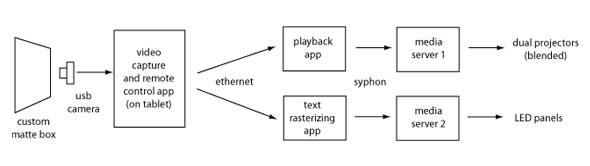
To bring the audience into the experience, I designed and implemented a capture and playback system that also provided a single point of control for the media servers.
The portable camera rig included a custom mattebox with integrated lighting and a tablet app for video capture and remote contol of the playback component and media servers. Captured video was sent to a file server, then cued by the remote control and played back by a custom playback app to the media server (which handled warping and blending for the visor surface). Another app handled rendering the names as text for the name badge, sending a video feed to a second media server driving the LED panels.
portable video capture rig in action We used this rig to capture video clips of attendees, as well as of several of the artists performing at the festival. For attendees, we’d sequence the playback in such a way as to allow individuals time to capture images of themelves as the astronaut. In the case of performing artists, we’d often position the astronaut near the stage during the set so the artists could look out over and see themselves looming over their audience.
The on-site production demanded constant interaction with the social media team as well as artists’ representatives – as we’d not just be capturing content on site but also pulling images from socal media channels. When these assets (“selfies on the grandest of scales”) were displayed on the astronaut we’d often need to coordinate getting photographs to send back out to the social media world. The intent was to create an experience not just for the audience at the event, but for fans around the world.
Check out this recent interview with Patrick Shearn of Poetic Kinetics.


